For sidewalk and driveway snow clearing in Lincoln, Nebraska, property owners must clear snow and ice from sidewalks by 9 a.m. the day after a snowstorm ends and keep them clear during the day. The cleared path must cover the full sidewalk width, including adjoining wheelchair ramps and curb cuts.
That deadline is easier to manage when you know exactly what needs clearing and how drifting snow can bring the work back after a storm. This guide explains Lincoln’s sidewalk rules, the areas around driveways and corners that need attention, and practical details about local snow-clearing service areas. You’ll also learn what can affect snow-shoveling prices and how to assess seasonal offers, so you can plan ahead and keep your property accessible through winter.
Lincoln property owners’ sidewalk snow-clearing deadline
Lincoln property owners must clear snow and ice from sidewalks by 9 a.m. the day after a snowstorm ends. The sidewalk must also remain clear during the day.
Sidewalk Snow and Ice Deadlines
A sidewalk-clearing deadline is the time by which a property owner must remove snow and ice from the public walk beside their property. In Lincoln, the deadline is 9 a.m. on the day following the end of a snowstorm, and sidewalks must stay clear during the day.
The same deadline applies to accumulated snow and ice on the sidewalk. Clearing only a narrow strip is not enough: remove snow across the full width of the walk and from adjoining wheelchair ramps or curb cuts. After a complaint about an uncleared sidewalk, the City gives the property owner written notice on the front door or another conspicuous place on the property.
Lincoln’s described process does not set a fixed dollar fine for failing to clear a sidewalk. If a reported problem remains unresolved and is reported again, the City may hire a contractor and charge the property owner. Separately, pushing or blowing snow into or onto a street, alley, or sidewalk is illegal and may result in a fine.
The sidewalk-clearing duty applies to property owners, including owners of rental properties. Residents are responsible for clearing their own driveways, but the stated city requirement applies to sidewalks, not private driveways. When clearing a driveway, keep snow out of the street, alley, and sidewalk.
Residential parking bans follow an even- and odd-year pattern that can affect where vehicles may remain during snow operations. According to the City of Lincoln, parking is prohibited on the even-numbered side of the street in even-numbered years, such as 2024. According to the City of Lincoln, bans prohibit parking on the odd-numbered side in odd-numbered years, such as 2025.
Snow-Clearing Safety and Property Risks
Safe snow clearing means removing snow and ice while protecting people using the walk and avoiding property damage. Slippery, uncleared sidewalks can make passage unsafe, while snow across curb cuts or wheelchair ramps can block accessible routes. Clear the full sidewalk width and adjoining ramps, not just the section nearest a doorway.
Pay attention to where cleared snow goes. Pushing or blowing snow onto a street, alley, or sidewalk is illegal in Lincoln and may result in a fine. Snow placed across a walkway can also obstruct a route that was already cleared. Keep pedestrian paths open as you move snow.
Snow-removal work can affect objects in the right of way between paved streets and sidewalks. In Lincoln, property owners are responsible for maintaining, replacing, or repairing objects there that are damaged by City activities such as snow removal. This makes careful placement and protection of items near the street worthwhile. For Lincoln homeowners considering other seasonal property needs, pest control in Lincoln is a separate service from winter sidewalk clearing.
Clearing the full sidewalk width and curb cuts
A complete sidewalk-clearing pass removes snow across the entire walk, including adjoining curb cuts and wheelchair ramps. In Lincoln, plan the work around driveway edges too, where plowed street snow can collect.
A practical plan for sidewalk and driveway snow clearing Lincoln homeowners can follow starts by mapping each route: sidewalk, curb cut, ramp, and driveway. Clear each as a separate section, then check that snow hasn’t been pushed back across another part of the route.
Place shoveled snow on your property where it won’t block a sidewalk, curb cut, wheelchair ramp, or driveway entrance. Don’t push or blow it into or onto a street, alley, or sidewalk. Lincoln prohibits that, and violators may be fined.
Clear the entire walk and accessible routes
Full-width clearing means removing snow from one side of the sidewalk to the other, rather than opening only a narrow footpath. Clear adjoining wheelchair ramps and curb cuts too, so the route remains continuous from sidewalk to street.
Corner lots need an extra pass at the intersection. Check each sidewalk segment and the curb ramps that meet it. A clear stretch along the property won’t keep the corner accessible if snow remains on a ramp. Clear the ramp edges as well as its sloped surface.
Make room beside driveway entrances
A driveway opening is the space where a private drive meets the street. Lincoln Transportation and Utilities recommends clearing snow up to 10 feet to the left of a driveway, making room along the curb for plowed snow.
Use the driveway entrance and curb as landmarks. Clear the approach to the street, then leave room on the left side for snow displaced by plows. This helps keep the entrance usable after street clearing, rather than narrowed by a snowbank.
Think of the work as connected paths: sidewalk, curb cut, ramp, and driveway access. Clearing only the driveway leaves the public walk obstructed; a cleared sidewalk can still be difficult to use if its adjoining ramp is buried. Check each transition point after moving snow.
For a service scope, identify the sidewalk’s full width, its adjoining curb cuts and ramps, and the driveway route. This sidewalk and driveway snow clearing Lincoln homeowners plan should also account for the 10-foot space left of the driveway as a separate curbside consideration.
In Lincoln Park, Michigan, residents are encouraged to clear a 5-foot-wide sidewalk path whenever possible. When planning the work, use that width as a practical guide for keeping the route open, while still clearing adjoining curb cuts and ramps. Check that the path connects with each transition rather than narrowing or stopping at an entrance.
If conditions make a 5-foot-wide path impractical, clear as much of the sidewalk as possible and keep the route continuous. Pay attention to places where snow moved from one section could obstruct another. After clearing, review the sidewalk and its connections together, so a usable path does not end at a curb cut, ramp, or driveway approach. This helps keep the whole route easier to navigate.
Snow shoveling across Lincoln neighborhoods
Neighborhood snow clearing means keeping property access usable as snowfall and drifting change conditions. In Lincoln, wind across the open plains can blow snow back over sidewalks and driveways after a storm. A route that was clear when snowfall ended may need another pass when drifting covers it again.
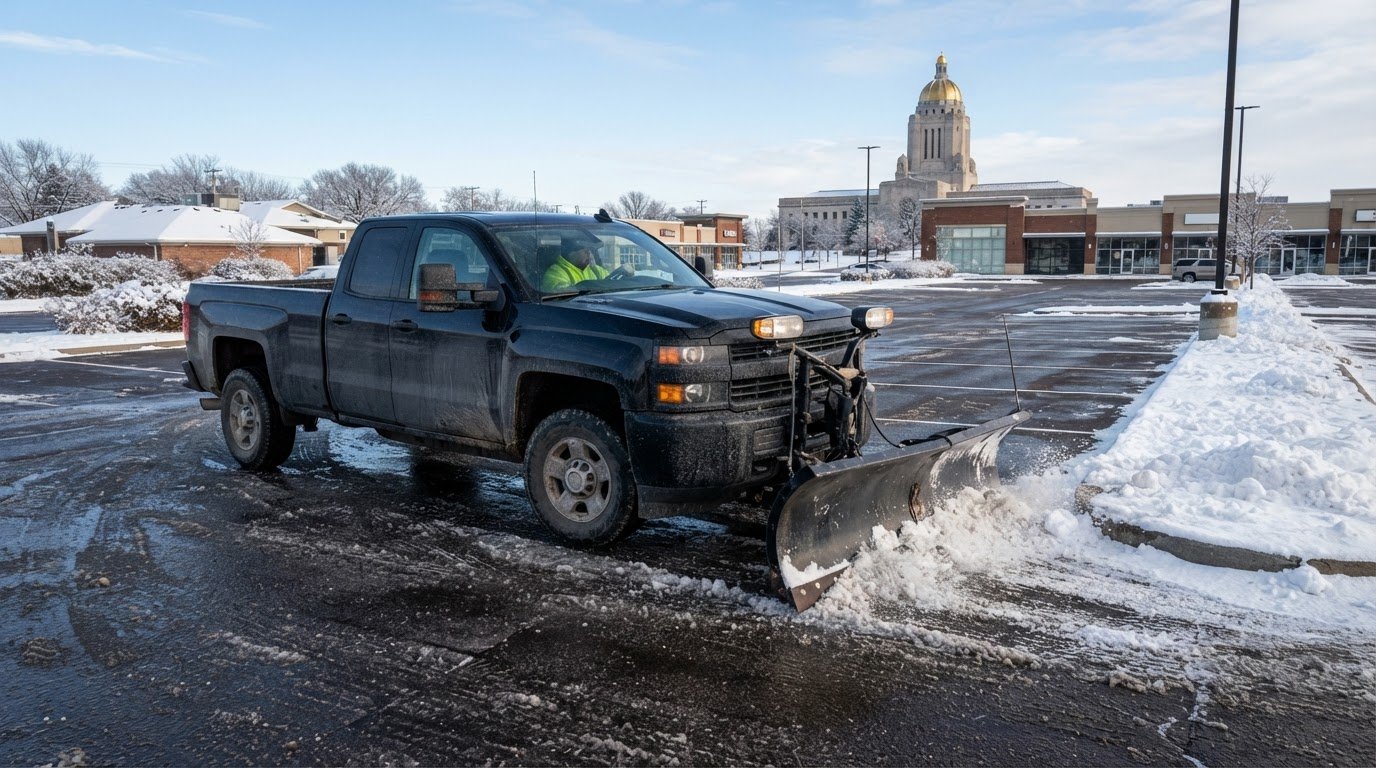
Shoveling moves snow by hand; a snow blower discharges snow, while a plow pushes it aside with a blade. For a Lincoln driveway, shoveling gives you direct control over where snow goes, while blowing and plowing can move snow across a broader area. Choose based on the area to clear, available equipment, and where displaced snow can safely go.
Lincoln Transportation and Utilities recommends shoveling every couple of hours during heavy snowfall. Clearing in stages avoids facing the full accumulation all at once. For example, clear a route during the storm, then return as more snow falls. Wind can still create drifts, so check exposed driveway entrances and sidewalk stretches when conditions change.
Fire hydrants and paths to the street also need attention during neighborhood clearing. Lincoln property owners are encouraged to clear snow around hydrants and shovel a path to the street, helping Lincoln Fire and Rescue respond to fires. Include both in your routine: open access around the hydrant, then make a direct path from the property toward the street.
Lincoln’s Snow Angels program is intended to help residents who are physically unable to clear snow from driveways or sidewalks. The city compiled a map of volunteers willing to help residents in need. This community option serves a different need from routine property maintenance: residents who cannot safely do the work may benefit from volunteer assistance.
Neighborhood conditions affect how much follow-up a route needs. An open driveway may collect drifting snow after a storm, while a sheltered walk may stay clearer. Check the driveway entrance, sidewalk, hydrant area, and path to the street after wind moves snow. If a drift blocks one section, clear it without pushing snow onto a street, alley, or sidewalk.
Plowing, blowing, and shoveling differ mainly in how they move snow and the area they can cover. A plow pushes snow aside, a blower throws it away from the cleared surface, and a shovel moves smaller amounts by hand. Choose the approach based on driveway size, drift patterns, and safe space for the snow.
Across Lincoln neighborhoods, a useful routine combines repeat checks with attention to access points. Revisit exposed sidewalks after windy weather, keep hydrants reachable, and maintain a path toward the street. These steps help prevent drifting from closing off routes that residents and Lincoln Fire and Rescue may need.
Snow shoveling prices and offers
A snow-clearing quote estimates the work requested and the property’s conditions. For a Lincoln driveway, key factors include the area to clear, snow depth, access, and whether sidewalks or curb cuts are included.
There is no single price for every driveway. A short, open drive requires different work from a longer drive with a narrow entrance, sidewalk, and adjoining curb cuts. Snow depth matters too: a heavy storm creates more snow to move than a light snowfall, and drifting can add work after the storm.
When requesting a quote, describe the areas involved rather than saying only “the driveway.” Specify whether the work includes:
- The full driveway from the garage or parking area to the street
- Sidewalk sections bordering the property
- Adjoining wheelchair ramps or curb cuts
- Snow buildup near the driveway entrance
- Additional clearing after drifting or continued snowfall
These details define the job and make quotes easier to compare. One quote, for example, may cover only the driveway, while another includes the adjoining sidewalk. The work included matters as much as the headline amount.
A seasonal offer is a promotion tied to a stated service or period. Read its terms for covered areas, service frequency, snowfall conditions, and exclusions. A lower rate may cover fewer areas or visits, so compare the work included, not just the offer wording.
Pricing depends on the property and is provided in a personalized quote. Key factors include clearing area, snow depth, access, and requested scope. Describe each surface and access point that needs attention. A corner property with a driveway and adjoining sidewalk, for instance, has a different scope from a driveway without sidewalk frontage.
Also distinguish a one-time clearing from a seasonal arrangement. A one-time request covers a specific storm or accumulation, while a seasonal arrangement sets out recurring service terms. Ask for the scope and applicable conditions in writing, so you understand how later snowfall or drifting affects the work.
Offers are most useful when their terms match the property’s needs. When comparing options in Lincoln, use the same checklist for each quote: areas included, snow conditions covered, service frequency, and how drifting is handled. This keeps the decision focused on the work required, rather than an advertised amount alone.
These figures offer a general point of comparison, not a guaranteed quote for a particular property. The final amount may reflect the surfaces requested, access, snow depth, and whether the job involves a one-time visit or recurring service. If an estimate differs from typical costs, ask which work and conditions account for the difference. Confirm that it covers the same scope you described, including sidewalks or curb cuts, before choosing an offer.
Snow-clearing services in nearby communities
A nearby-community service area includes places a provider serves beyond its central city. For Lincoln residents, first identify the municipality where each property is located. A mailing address that includes “Lincoln” may not establish which local government’s sidewalk rules apply. Use the property’s actual location when planning winter clearing.
Municipal boundaries matter because snow rules and enforcement can differ between cities. Lincoln’s sidewalk deadline does not automatically apply in a nearby community. Before arranging clearing for another property, identify its municipality and review that government’s current sidewalk requirements. This is especially important for owners managing a home in Lincoln and a rental property elsewhere.
Service-area planning depends on the work location, not just the owner’s home address. Someone living in Lincoln, for example, may need a sidewalk cleared at a property across a municipal boundary. Keep the property address, municipality, and requested surfaces together when describing the job. This identifies the location and scope without assuming neighboring jurisdictions share Lincoln’s rules.
Nearby-community coverage is a geographic question, separate from the clearing task. A request might involve a driveway in Lincoln, a sidewalk in another town, or multiple properties in different jurisdictions. Each location has its own access points and clearing needs. Describe each property separately, including whether the work involves a driveway, sidewalk, curb cut, or walkway.
For owners coordinating several properties, a simple location list can prevent mix-ups. Record each street address, the municipality, and the areas needing attention. Then keep local deadlines and instructions beside the matching address. For instance, don’t apply Lincoln’s 9 a.m. deadline to a property elsewhere without confirming that municipality’s rule. The correct location determines which local requirements apply.
Lincoln residents seeking snow-clearing help in nearby communities should distinguish three questions: where the property is, what needs clearing, and which local rules apply. These details make a request more precise and help avoid confusing one property’s sidewalk obligations with another’s. Treat a Lincoln home and an out-of-town rental as separate jobs, even if one owner manages both.
For property-care planning around Lincoln, contact the team about your seasonal needs. Include the property’s municipality and the surfaces involved, so the conversation starts with clear, useful details. That practical distinction helps keep local requirements attached to the right address rather than treating every nearby community as part of Lincoln.
Yardworx Lawn & Landscape: Snow & Ice Removal
Yardworx Lawn & Landscape provides Snow & Ice Removal for property owners in Lincoln and neighboring towns who need help keeping winter access clear. It’s a practical option when snowfall, ice, or repeated clearing makes winter upkeep difficult. Describe the areas that need attention, such as a driveway or walkway, so the requested work is clear from the start.
For seasonal care beyond winter, Yardworx also provides Weekly Lawn Mowing Services and Leaf Removal. Choose the service that fits the season and your property’s needs.
Contact Yardworx Lawn & Landscape to discuss Snow & Ice Removal for your property.
Make winter property care part of your seasonal plan
Planning sidewalk and driveway snow clearing in Lincoln is also a chance to think ahead about your property’s needs as seasons change. A steady plan can make the shift from winter maintenance to spring lawn care more manageable, without leaving outdoor tasks until they become urgent.
Yardworx Lawn & Landscape offers a 6-Step Fertilizing Program and Aeration & Overseeding to support lawn care beyond the winter season. Consider which services fit your property and the time you want to spend maintaining it. A clear conversation about your priorities can help you choose a practical next step.
Contact Yardworx Lawn & Landscape to discuss your property-care needs. With a thoughtful plan in place, you can look forward to a well-kept outdoor space through the changing seasons.