
A yellow lawn doesn’t always need more water or fertilizer. If “why is my lawn turning yellow Nebraska” is the question on your mind, start by noting where the color changed and what happened beforehand. A few dry-looking patches, broad fading, or yellowing after a change in watering can point to different causes. Discoloration is a symptom, but it doesn’t automatically mean your lawn is dying.
Before treating the problem, check the pattern, the season, and the growing conditions in the affected area. Extra water or fertilizer may not help if the issue is uneven irrigation, nutrient stress, pests, disease, or another cause. A few careful observations can help you avoid a guess that makes the lawn harder to manage.
This guide covers common causes of yellow grass in Nebraska, visible clues that can help narrow them down, and practical checks to make before applying a treatment. It also explains how routine care, including fertilizing, aeration, lawn treatments, and irrigation maintenance, can support turf health when those services fit the condition.
Why Is My Lawn Turning Yellow in Nebraska? Start With the Clues
If you’re asking, “why is my lawn turning yellow Nebraska,” start with the shape and location of the discoloration rather than reaching for fertilizer or the hose. Yellowing is a visible symptom, not a diagnosis. Water stress, nutrient issues, pests, disease, and ordinary wear can all affect grass. The same cause won’t explain every lawn.
Nebraska lawns experience changing seasons and periods of heat, dry weather, and rainfall. These conditions can affect turf, but they don’t point to one automatic fix. A quick, structured check can help connect what you see with what’s happened around the lawn. Turfgrass includes the grasses commonly maintained as lawns, but the details of the affected area are what help guide your next step.
What does the yellowing pattern reveal?
Look across the whole lawn before focusing on one blade. Scattered spots, a sharply defined patch, a ring-shaped area, and broad, even fading are different patterns worth recording. None proves a cause by itself, but each can help narrow what to investigate. Note whether the discoloration follows a feature or activity in the yard.
- Scattered spots: Note whether they’re isolated or appearing in several parts of the yard.
- Defined patches or rings: Record their approximate size and whether the edges look sharp, irregular, or rounded.
- Broad fading: Check whether the color change is fairly even or worse in particular sections.
- Location clues: See whether the area follows a sidewalk, shaded spot, sprinkler coverage, or a pet’s usual route.
Take a photo from the same spot every few days and note whether the yellow area is spreading, shrinking, or staying put. Look closely at grass within and around the patch, too. A consistent change at an edge or along a route can be more useful than color alone. Keep your notes simple so you can compare conditions before choosing a response.
What changed before the Nebraska lawn turned yellow?
Think back to when you first noticed the change. Did it appear after a hot or dry stretch, heavy rainfall, a shift in irrigation, or a seasonal transition? Consider recent mowing and lawn treatments as well. Timing doesn’t establish the cause, but it gives you a sensible starting point for checking what changed.
- When did the yellowing first appear, and did it develop quickly or gradually?
- Has rainfall or your watering routine changed? Is the pattern near a sprinkler or between coverage areas?
- Did mowing height or frequency change before the symptoms showed up?
- Were lawn treatments applied recently? Record what was applied and when.
Compare the affected turf with a nearby section that still looks healthy. Check whether both areas receive similar sunlight, water, and foot traffic. If they differ, that contrast may help explain why one area changed while the other did not. For irrigation concerns, irrigation maintenance can help keep watering equipment working as intended.
Identify the pattern before treating the lawn, so your response addresses the likely problem instead of adding water or fertilizer that may not be needed. Keep photos and notes together to make your next decision more informed.
Common Causes of Yellow Grass in Nebraska: The Clues That Separate Them
Yellow turf can reflect stress, dormancy, or damage, not only nutrient deficiency. So if you’re asking “why is my lawn turning yellow Nebraska,” resist treating color as proof that grass needs fertilizer. Compare the pattern with recent weather and lawn care, then look for signs that distinguish one possibility from another. Several causes can look alike, and more than one may affect a lawn at once.
How water, weather, and soil conditions affect turf color
Weather is useful context, not a diagnosis. Nebraska’s changing seasons and periods of heat, dry weather, or rainfall can influence turf, but the response varies with the site and its care. Check the ground and how water moves through it. Dry, stressed grass may appear dull or wilted, while turf in persistently wet or poorly draining spots may also thin or yellow. Neither appearance identifies the cause on its own.
- Possible water stress: Check whether discoloration is concentrated where sprinkler coverage is weak or where the soil seems dry.
- Persistently wet soil: Notice low spots or areas that stay soggy after nearby ground has drained.
- Compaction: Heavily walked or driven-on areas may have dense soil that restricts healthy root growth and makes it harder for water to move through the ground.
Compare the affected spot with nearby turf that gets similar sun and water but less foot traffic. If compacted soil is the main difference, adding water may not address the underlying issue. Aeration can help relieve soil compaction when that condition is present; it isn’t a blanket fix for every yellow patch.
When mowing, nutrients, pests, or disease may be involved
Check the lawn’s recent care and the grass itself. An uneven cut or a sudden change in mowing may leave some areas looking stressed. A nutrient issue is possible, but fertilizer applied without identifying the need can create additional stress or damage, particularly if too much is used. Recent feeding is a clue to record, not a reason to apply more.
- Mowing stress: Look for a change that follows an area cut too short or unevenly.
- Pests: Localized thinning or damaged turf may warrant a closer look, but color alone can’t confirm grubs.
- Disease: Expanding patches or rings can be a reason to investigate disease, though other problems can produce similar patterns.
- Seasonal dormancy: Grass may lose color during a seasonal shift or stressful weather without being permanently damaged. Check whether the change is widespread and whether conditions have recently shifted.
Grub damage, disease, water stress, and nutrient problems can overlap in appearance. Note when symptoms began, whether they’re spreading, and what the grass looks like at the edge of the affected area. If the cause remains unclear or damage continues to expand, avoid guessing with a treatment. Yardworx’s lawn fertilizing program supports ongoing turf care. Fertilizer should fit the lawn’s needs rather than serve as a default response.
How to Diagnose a Yellow Nebraska Lawn Without Guessing
Use your observations to narrow the possibilities, not to declare a diagnosis. A small discolored area may have a different cause from yellowing across most of the yard, and a patch that’s expanding deserves more attention than one that stays unchanged. Ask “why is my lawn turning yellow Nebraska” with three details in mind: the pattern, what changed beforehand, and the conditions at that specific spot.
Combining pattern, timing, and site conditions is more useful than relying on color alone. Use the comparison below to choose what to inspect next, not as a guarantee of what caused the damage.
| Visible pattern | Recent change to consider | Possible cause category | Next useful observation |
|---|---|---|---|
| Isolated spots | Pet route, localized traffic, or uneven sprinkler coverage | Localized wear, water stress, or other damage | Check nearby blades, soil moisture, and irrigation reach |
| Rings or expanding patches | Recent weather shift or a change in lawn care | Disease, pests, or another localized stress | Note whether the edge is spreading and inspect the grass within it |
| Yellowing along an edge | Changes in mowing or conditions beside pavement | Mowing or site-related stress | Compare grass height and soil moisture with nearby turf |
| Broad, uniform fading | Seasonal transition, weather, irrigation, or recent feeding | Widespread stress, dormancy, or nutrient concern | Compare open turf with shaded areas and review recent care |
Match the symptom pattern to the next useful check
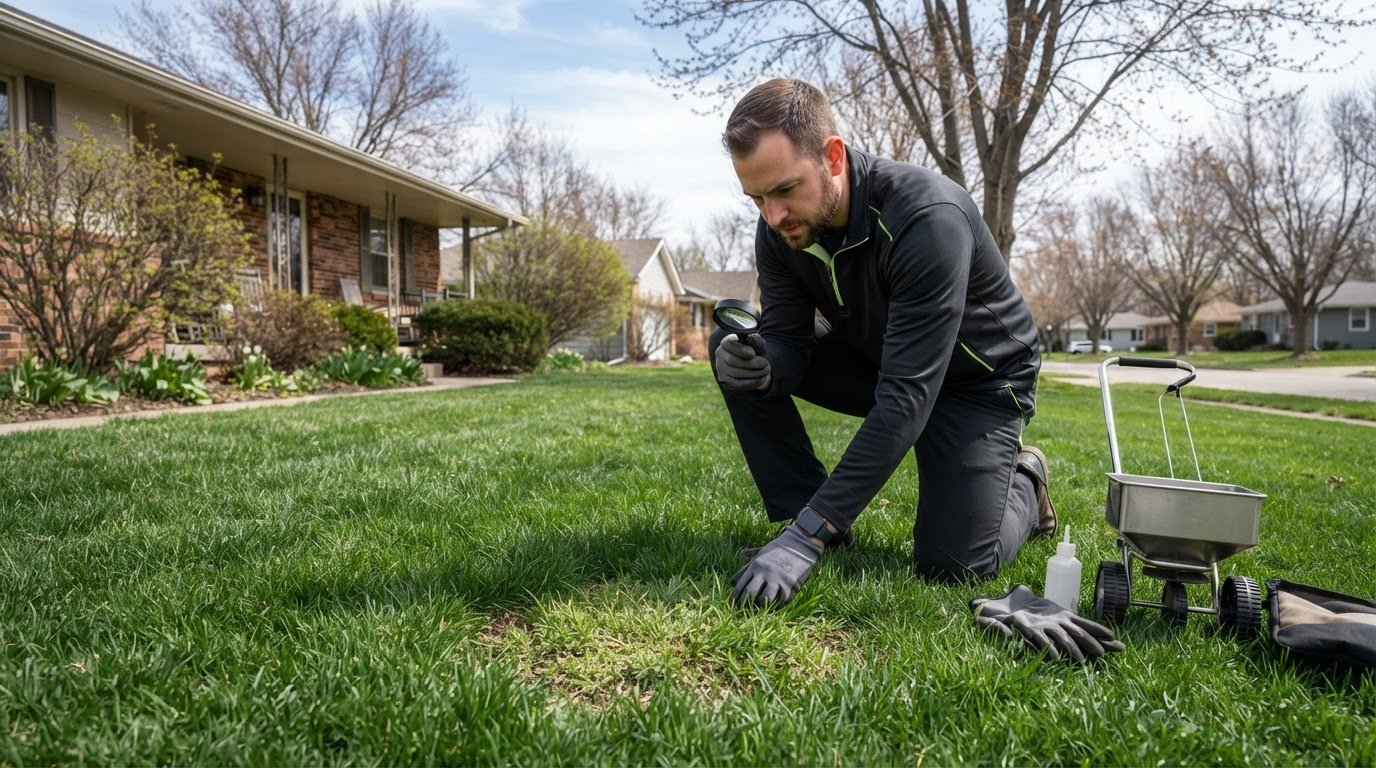
Look closely at a few blades from both affected and healthy areas. Note whether the grass is discolored throughout or mainly near the tips, and whether it looks cut unevenly. Gently check the soil’s moisture and, if practical, examine a small section of roots for signs of damage. Then compare sprinkler coverage. Shaded, compacted, or frequently walked-on ground may behave differently from open turf, even within the same yard.
Keep the check consistent: compare similar-sized spots and record whether symptoms worsen. A single observation can be misleading, but repeated notes can reveal a trend.
When a soil test or closer inspection can help
If nutrient problems seem possible, a soil test can provide more useful information than judging color and applying fertilizer by guesswork. Nebraska Extension is a resource for current soil-testing guidance; follow its latest instructions for sampling and next steps. Don’t use a test result to explain every patch automatically, since pests, disease, or root damage may still need closer inspection.
If damage continues to spread or the cause remains uncertain, a closer look at the lawn can help guide an appropriate response. Yardworx’s lawn care services support ongoing turf needs, with treatments selected to fit the observed condition rather than used as a catch-all fix.
What to Do When Your Nebraska Lawn Turns Yellow
Once you’ve noticed where the yellowing is and what may have changed, resist the urge to treat the whole lawn at once. If you’re asking “why is my lawn turning yellow Nebraska,” a few practical checks can help you choose a measured next step. Document the symptoms, check moisture and sprinkler coverage, inspect the turf, then respond only when the clues point to a likely need.
Simple checks to make before treating the lawn
Start with the affected area and a nearby patch of healthier grass for comparison. Feel the soil, look at the blades and roots, and check whether water reaches the spot consistently. Note recent mowing, visible pest activity, damaged grass, or any product application. Take photos from the same angle and keep them with your notes, so you can tell whether the patch is stable or changing.
- Check moisture: Is the soil notably dry, or does it stay wet compared with nearby ground?
- Check coverage: Observe whether sprinkler water reaches the yellow area evenly, rather than assuming the system covers the full lawn.
- Inspect the turf: Look for uneven cutting, visible insects, blade damage, or thinning roots, and compare these signs with unaffected grass.
- Record recent care: Write down mowing changes, watering adjustments, and lawn treatments, including when they occurred.
Monitoring can make sense if the affected area is small, stable, and not showing clear signs of serious damage. Recheck it under similar conditions and compare your photos. If the yellowing is spreading, turf is thinning quickly, or roots and blades look damaged, don’t rely on repeated guesswork. A closer look can help distinguish problems that may look alike.
Choose a response that fits the suspected cause
Change care only when observations support it. If the soil is dry and sprinkler coverage misses the patch, adjust watering to address that specific issue. If the area remains wet, adding more water could make conditions worse. Avoid a fixed schedule that ignores rainfall, soil, shade, and sprinkler performance.
For nutrient concerns, use soil-test findings to guide fertilizer choices instead of feeding by appearance alone. Excess fertilizer can stress or damage turf, so more is not automatically better. If observations suggest compacted soil, aeration may be relevant; if water delivery is uneven, irrigation maintenance may address an equipment issue. Neither is a universal cure. Yardworx provides irrigation maintenance to help keep watering systems functioning as intended, while routine lawn care supports turf health over time rather than promising an instant color change.
When the cause remains unclear or damage keeps spreading, lawn care can help match the next step to the condition you’re seeing. Get help assessing your lawn and move forward with a plan based on its actual needs.
How Lincoln Lawn Care Can Help Restore Healthier Nebraska Turf
Some yellowing clears as conditions change, while recurring patches or uncertain causes can make lawn care harder to manage alone. If you’re still asking “why is my lawn turning yellow Nebraska,” use what you’ve observed to guide the next step rather than treating every discolored area the same way. Ongoing care can address an identified need and support turf health over time, but it isn’t an instant fix for every yellow patch.
Match lawn care to the diagnosed need
Once the likely cause is clearer, choose care that fits. If nutrient concerns are supported by soil information and lawn conditions, Yardworx’s six-step fertilizing program provides structured nutrient care. The right approach depends on the lawn; avoid adding fertilizer simply because the grass looks pale. Explore the fertilizing program details to learn about this ongoing care option.
Compacted soil may call for aeration, and overseeding may be appropriate when the lawn also needs help filling in. These services address different needs than fertilizer, so they’re most useful when the observed condition points toward them. If the issue appears tied to uneven water delivery, investigate irrigation coverage instead of adding nutrients. Irrigation maintenance can help address system concerns that affect how water reaches the lawn.
Lawn treatments may also fit when the signs suggest a specific turf problem. Because pests, disease, and other stress can resemble one another, avoid assuming that a treatment is needed based on color alone. Matching care to the condition helps keep the plan focused and avoids treating the whole yard unnecessarily.
Build a steady plan for a healthier Lincoln lawn
A practical routine starts with observation. Keep track of where discoloration appears, how it changes, and what care the lawn receives. That history can make recurring issues easier to recognize and help guide seasonal maintenance. Fertilizing, aeration, overseeding, treatments, and irrigation maintenance each serve a purpose when they match the lawn’s condition. Appropriate care can support turf health without promising immediate recovery.
For example, if one section repeatedly dries out while nearby grass stays healthy, compare sprinkler coverage before changing fertilizer. If the same area struggles under heavy foot traffic, consider whether compaction may be affecting it. These checks help turn a recurring yellow patch into a clearer maintenance question, rather than a reason to apply products at random.
Yardworx Lawn & Landscape provides lawn care for residential and commercial properties in Lincoln. If you’d like help connecting your observations with a suitable care plan, talk with Yardworx about your lawn.
Give Your Lawn a Clear Next Step
A yellow patch doesn’t have to lead to a string of rushed guesses. Keep a simple record of what changes and when, then use that history to shape a care plan that fits your lawn. If you’re still searching “why is my lawn turning yellow Nebraska,” steady observation can help you make better choices than reacting to every color change with extra water or fertilizer.
For homeowners who want consistent support, Yardworx is a locally owned and operated small business serving the Lincoln metro area. Its lawn care can include a six-step fertilizing program, lawn treatments, aeration and overseeding, or irrigation maintenance when those services fit the observed conditions. The goal is thoughtful, ongoing care, not a promise that every yellow spot will recover overnight.
Take the next step with a plan that fits your property. Talk with Yardworx about your lawn and discuss a practical way forward. Attentive care guided by what your turf needs can make a healthier-looking lawn a more manageable goal.
Frequently Asked Questions
Can yellow grass turn green again?
Yes, if the grass is still alive and the stress behind the color change eases, it may regain green growth. Look for fresh shoots from the base rather than judging recovery by older, yellow blades alone. A lawn affected by brief stress may respond differently from turf with damaged roots or crowns. Give the grass time to show new growth, and avoid trying to speed recovery with extra fertilizer unless there’s evidence it needs nutrients.
Is yellow grass always a sign that the lawn is dying?
No. Grass can turn yellow temporarily because of stress or seasonal dormancy and still be alive. A larger concern is turf that keeps thinning, exposes bare soil, or fails to produce new growth as conditions improve. Check whether the affected area is changing and compare it with nearby grass. If the lawn’s condition is declining rather than holding steady, investigate further instead of assuming the color will resolve on its own.
Why is my lawn turning yellow after a cold snap in Nebraska?
A cold snap can temporarily discolor grass or slow its growth, particularly during a seasonal transition. For anyone asking “why is my lawn turning yellow Nebraska,” consider whether the color appeared soon after a temperature change and whether the rest of the lawn looks similar. Avoid applying fertilizer just to counter the cold-related color shift. Watch for fresh growth as conditions settle, and investigate separately if damage is concentrated in distinct patches or keeps spreading.
How can I tell whether yellow grass is dormant or dead?
Dormant grass may look straw-colored but can retain living crowns and roots, while dead turf won’t resume growth. Gently part the blades near the soil and inspect the base: living tissue is generally more intact than a dry, brittle crown. This check isn’t definitive, especially during a seasonal transition. Track the area over time and look for new shoots before deciding that the lawn needs replacement or intensive repair.
Can overwatering make a Nebraska lawn turn yellow?
Yes. Soil that stays saturated can limit air around roots and leave grass looking yellow or weak. Look for clues such as water pooling, persistently soggy ground, or yellowing in low areas while nearby turf looks healthier. A sprinkler that runs too often or reaches one area repeatedly may contribute. Check the soil and irrigation coverage before changing your routine; adding more water could prolong the problem.
Should I fertilize my lawn as soon as it starts turning yellow?
No. Yellow color alone doesn’t confirm a nutrient shortage, and excess fertilizer can injure turf. Before feeding, review recent applications and consider whether a soil test points to a nutrient need. If fertilizer was applied recently, don’t add another dose to try to correct the color. Follow product-label directions for any treatment, and choose a response based on the lawn’s condition rather than using fertilizer as a general remedy.
When should I call a lawn-care professional about yellow grass?
Consider professional help if discoloration keeps spreading, returns in the same area, or appears alongside thinning turf, damaged roots, or possible pest or disease activity. These problems can resemble one another, so repeated trial-and-error treatments may waste effort or add stress. For a Lincoln lawn, Yardworx provides lawn care, lawn treatments, irrigation maintenance, aeration, and fertilizing to support turf needs. Choose care based on the symptoms and conditions you’ve observed.